Complex inside, simple outside.
Accesible Abstracts · Case study
Project details
- Product
- Abstracts platform
- Year
- 2026
- Role
- Development
- Standard
- WCAG 2.2 A/AA
The project
Accesible Abstracts is the platform a scientific conference uses to receive, assign and review its abstracts. We built it for ECI Conference Madrid 2027, run by AEIPI and Eurlyaid. By 2 November 2026 it had received 230 abstracts from 35 countries, with 826 author credits, spread across five themed tracks and 29 reviewers.
We then turned it into a product for other conferences. Version 2 is in development, built on what we learnt at ECI.
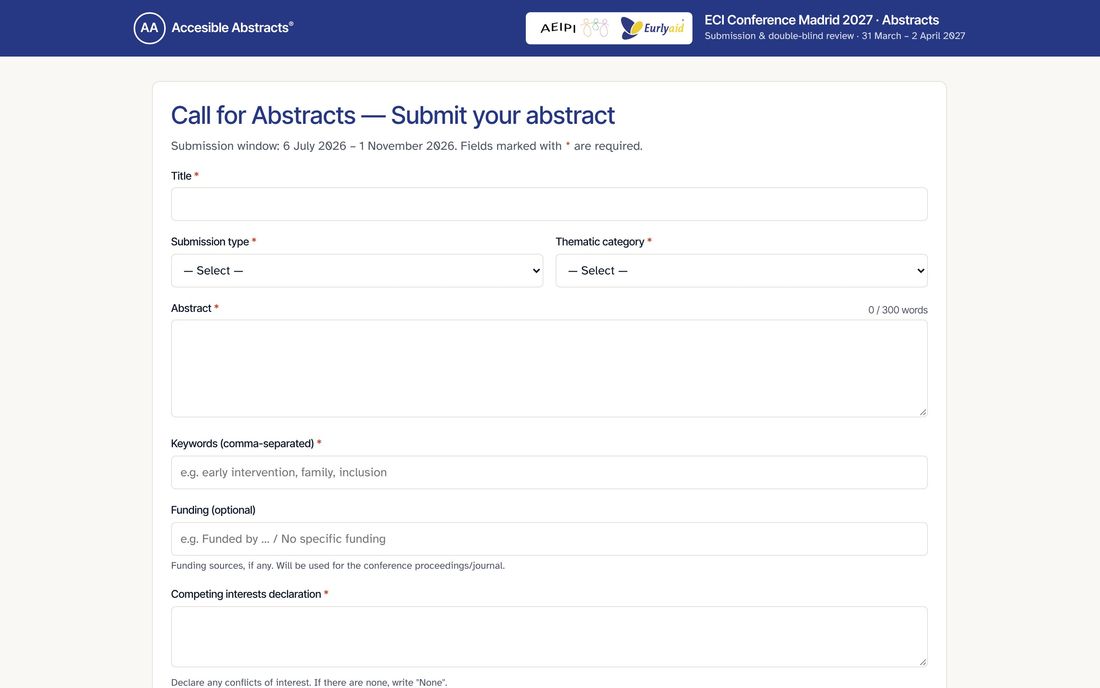
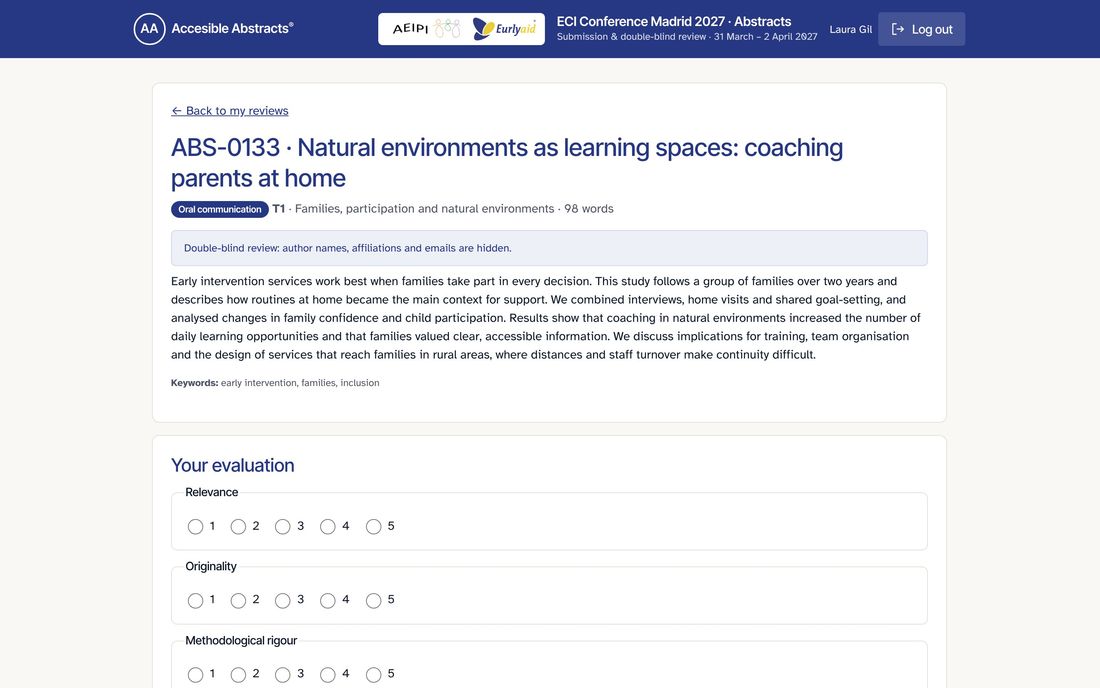
The submission form is ECI’s live one. The reviewer and committee screens are the same application with test data.
See the ECI Conference case study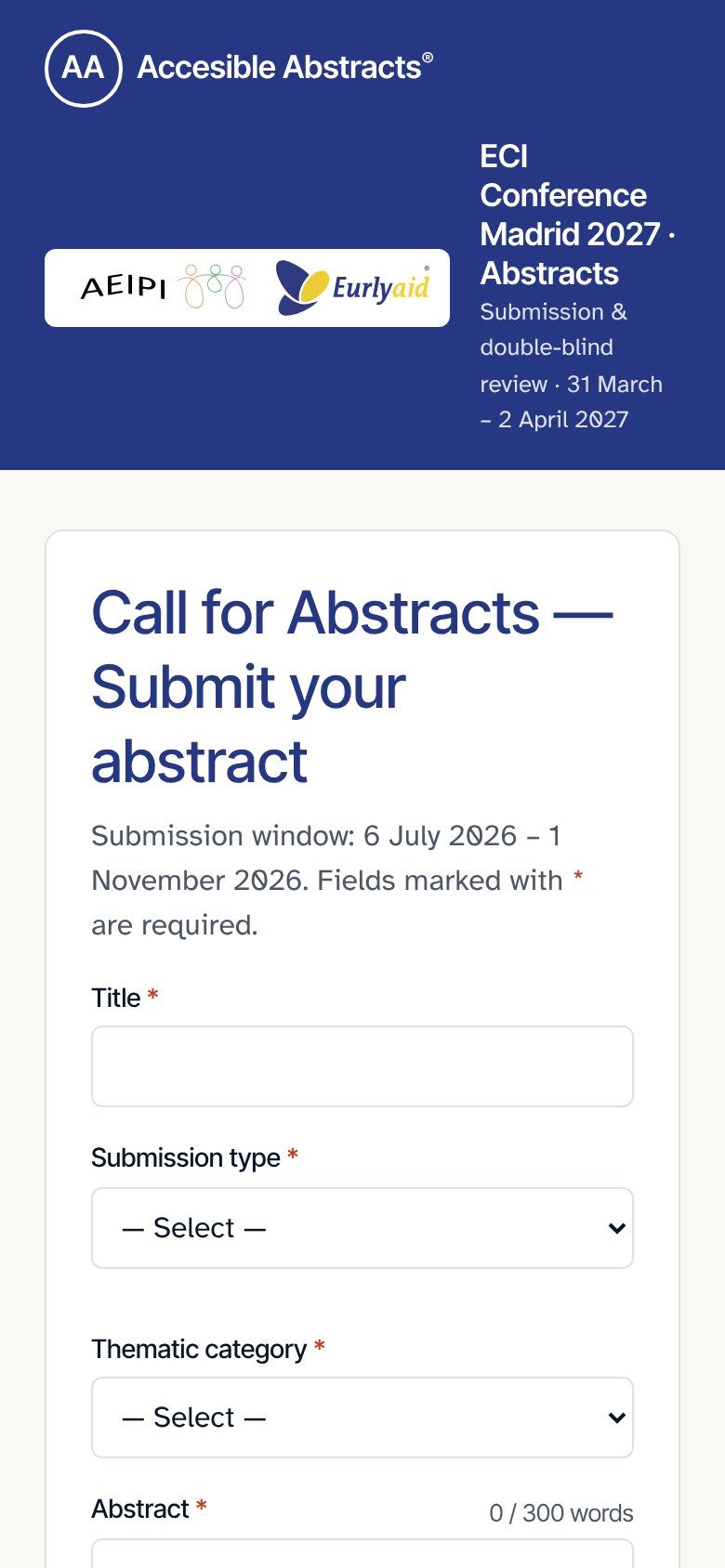
The challenge
Lots of process, little interface.
A conference like this handles submissions, authorship, conflicts of interest, peer review, scores, notifications and decisions. The usual tools deal with it through long forms and dashboards full of options, and they shut out anyone using a keyboard, a screen reader or zoom.
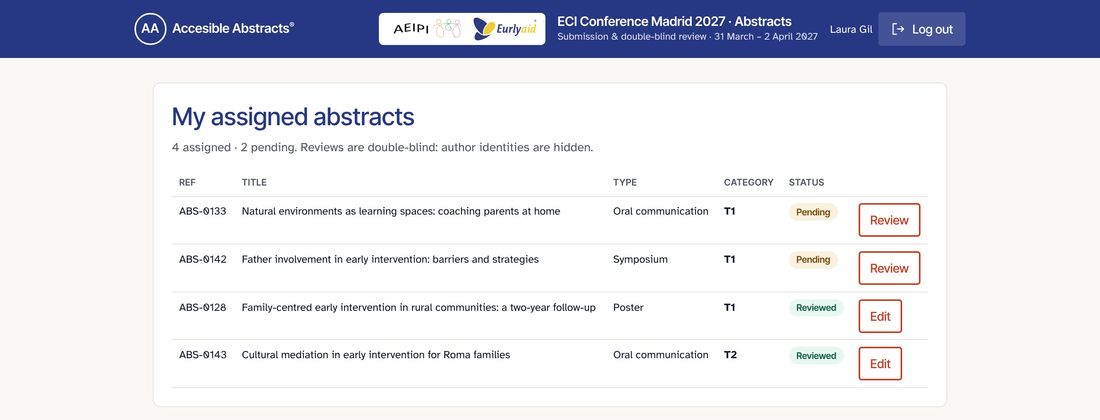
Everyone sees only what’s theirs.
Authors get a form, with no account to create. Reviewers get their abstracts and a scale from 1 to 5. The committee gets the status of everything and the decisions. The complexity stays inside.
The structure
From submission to programme, in four steps.
Authors submit their abstract and receive a confirmation with its reference. Each abstract is automatically assigned to two reviewers from its themed track, spreading the workload and ruling out conflicts of interest, whether declared or by affiliation.
Reviewers score six criteria from 1 to 5, can save halfway through and leave a comment for the committee. The committee decides, the authors are notified and everything is exported for the programme and the journal.
What we learnt
What ECI taught us.
Three out of four abstracts arrived in the last week before the deadline, and more than half in the final three days. That’s why review starts while submissions are still open: each reviewer gets their share as it comes in, without waiting for the deadline.
A real conference also brings what no specification covers: the same proposal submitted twice or by two co-authors, abstracts in another language, or someone who reviews and also signs as an author with a different email address. And the workload doesn’t balance itself: one themed track can have three times as many abstracts per reviewer as another.
Version 2 starts from there.
Design decisions
The hard part was the process, not the screens. Every decision saves someone a step.
Truly double-blind.
The authors’ names, affiliations and email addresses never reach the review pages. They aren’t hidden by design: they simply aren’t there.
No account to submit.
Whoever submits an abstract doesn’t have to register or remember a password. They get a confirmation with its reference, and that’s it.
Continuous review.
Abstracts are assigned as they arrive, with a daily summary for each reviewer: no avalanche at the deadline.
With each conference’s own brand.
It runs on each conference’s own domain and colours, on ordinary hosting and with no per-abstract licences. The data belongs to the conference.